What a wallet risk check reads — and what it never touches
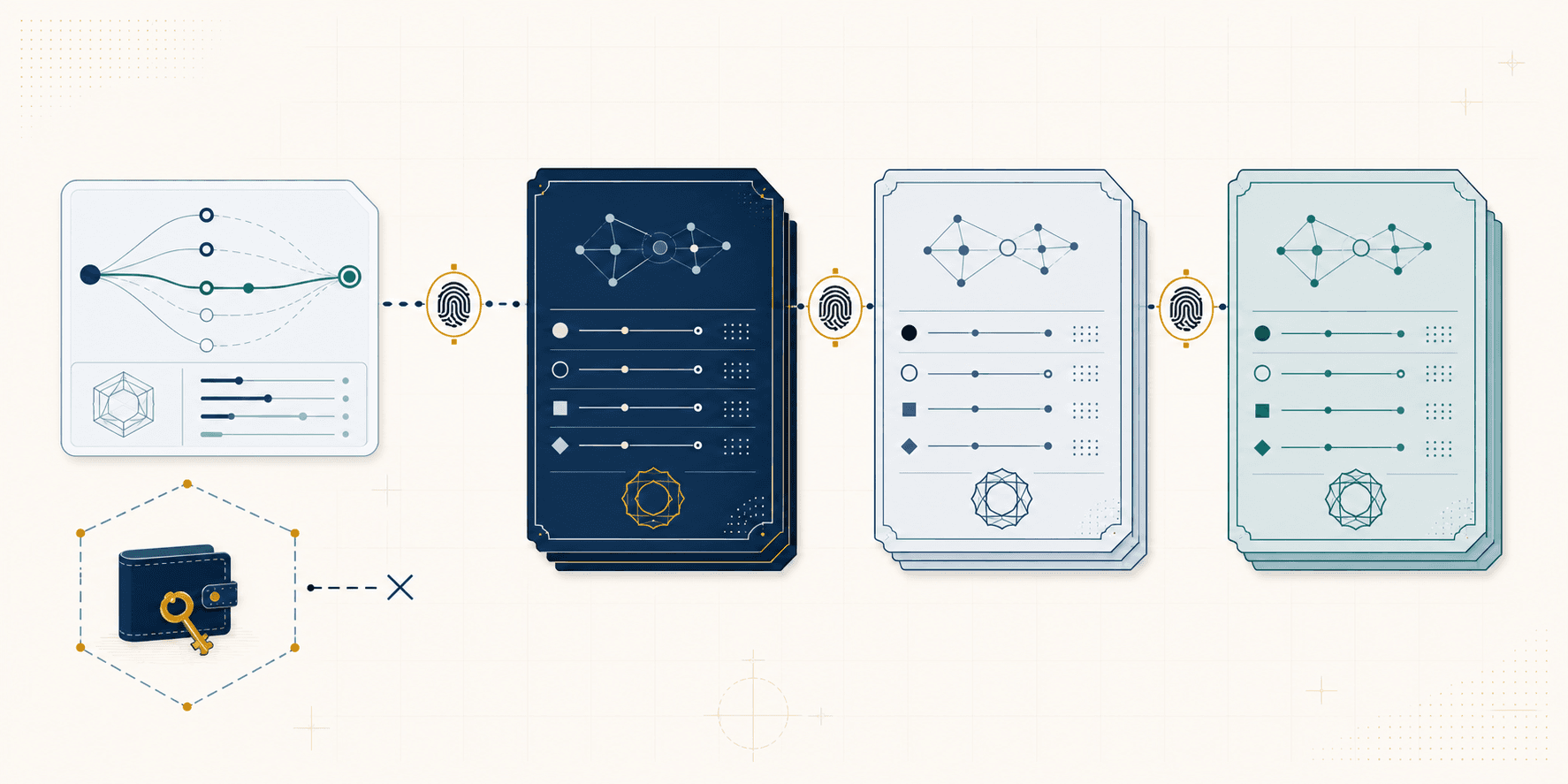
A wallet risk check starts from a single input: a public EVM address. Paste it and Routescore reads the supported-token balances at that address over public RPC — the same read anyone can run against the chain. It never asks you to connect a wallet, sign a message, approve a token, or hand over a private key, and it takes no custody of anything. The address is read-only input, and nothing leaves your control.
Coverage is deliberately narrow and labeled. Routescore prices and models a defined supported-token set; tokens, chains, and positions outside that set are marked as unsupported rather than silently approximated or scored as zero. If a balance cannot be read or priced on a given run, it is shown with that provenance — withheld, not fabricated — so you never mistake a coverage gap for a clean result.
Source freshness travels with the number. Holdings come from a public-RPC read plus the launch-static holdings catalog, and the report states whether that read was live, cached, or a fallback. A privacy boundary sits underneath all of it, and it is stated plainly: a public address is already public on-chain, so this is not an anonymity claim. Routescore keeps the boundary honest by working read-only, requesting no keys, taking no custody, and recording only hashed identifiers in its own analytics instead of storing the raw address as a tracking key.
- Input is a public EVM address — no wallet connect, no signature, no approval, no key.
- Supported-token coverage only; unsupported tokens and chains are marked, not approximated.
- Freshness is labeled live / cached / fallback, so a stale read is never disguised as fresh.
- Read-only and non-custodial throughout; analytics store hashed identifiers, not the raw address.
The first value moment needs no private wallet and no login
You do not have to risk anything to see what the tool does. The public sample wallet report renders the full artifact — supported holdings, modeled route exposure on the largest holding, coverage limits, and the trust metadata — before you type a single address. It is the same wallet_route_report.v1 contract a real check produces, pinned to a canonical fixture so anyone can inspect it end to end.
That is the honest version of value before signup: the inspectable artifact is public, and only persistence sits behind the login. Open the sample, read how a modeled route-leak figure is framed and caveated, then paste your own public address when you want your own numbers. No private wallet, no email, and no payment is required to reach that first moment.
What the wallet risk view tells you — and what it cannot
The view answers one narrow, useful question: for the supported holdings at this address, how much modeled route-quality leak would moving them at this size carry, and is there a lower-leak supported alternative? It is a point-in-time, modeled comparison — decision support for thinking about route choice before you act, not a quote, a verdict, or advice.
It is just as clear about its blind spots. It does not see unsupported assets or chains, off-chain risk, contract or token-approval risk, or where prices go next; those are named on the artifact, not buried in fine print. The figure is forward-looking and modeled, so it describes exposure, not a realized outcome — and it makes no promise about what any future swap will cost. When you act, you act in your own venue with your own settings, and Routescore stays read-only and non-custodial the whole way through.
Saving turns a check into a reviewable decision record
A single look is disposable; a saved check compounds. Sign in to save and the report persists the exact artifact — the address subject, supported holdings, modeled leak, model and catalog versions, source freshness, confidence state, and the named caveats — as a tamper-evident, hash-recorded decision record you can return to.
That record is what makes the call reviewable. Later you can attach an outcome label and see whether the modeled exposure tracked reality, which is how the methodology earns or loses credibility in the open instead of by assertion. Inspecting stays public and free; saving, exporting, and monitoring are the only things the login gates.