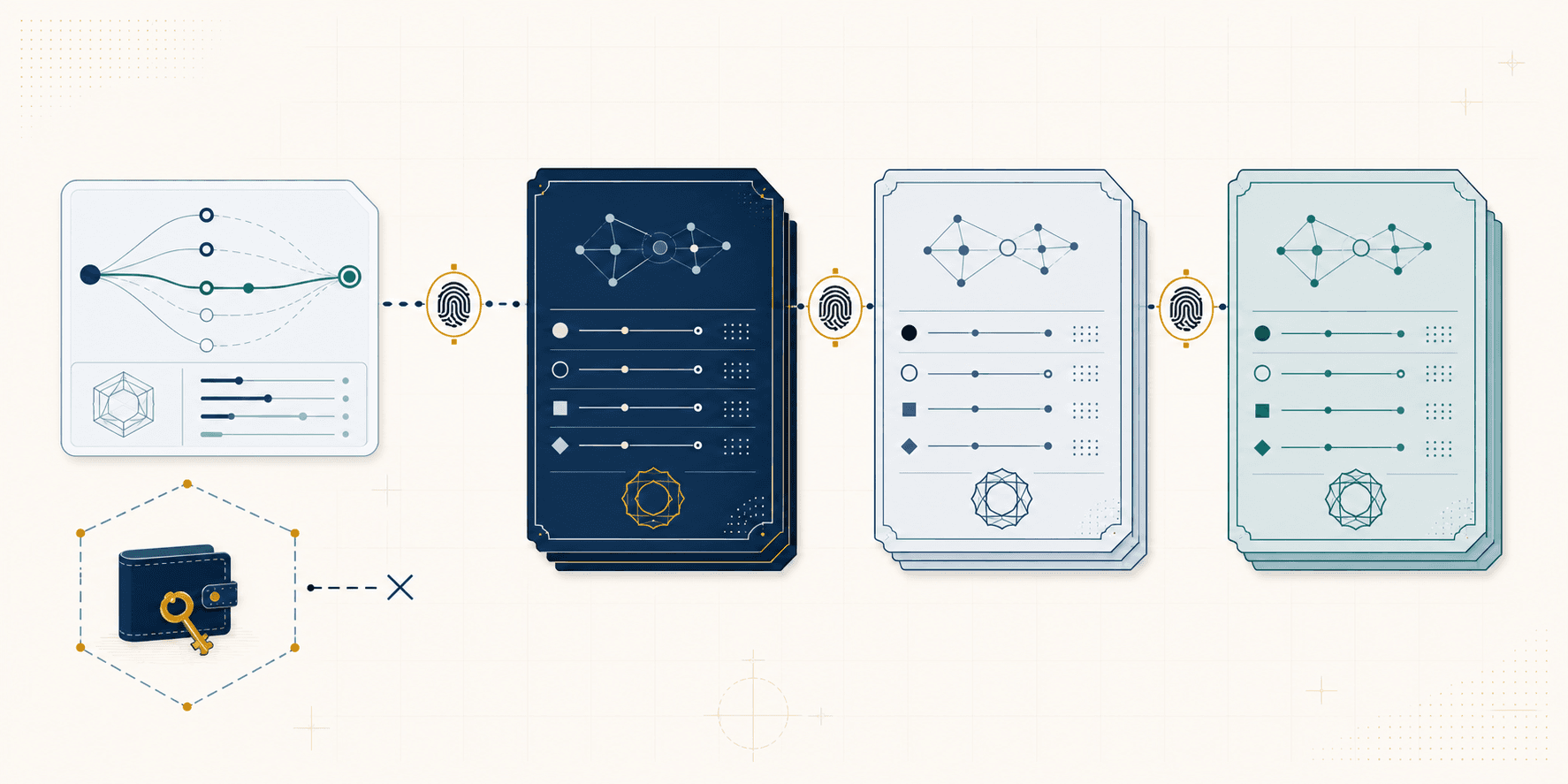
What a hash-recorded decision record is
A decision record is the saved trail behind a single call. When you save a route check, Routescore writes the inputs you entered, the modeled output it produced, and the surrounding context into one append-only entry, then computes a SHA-256 hash over the whole thing. That hash is what makes the record tamper-evident: change any field after the fact and the recomputed hash no longer matches the stored one, so a record cannot be quietly edited after the fact to look smarter in hindsight than the call actually was at the moment you made it.
It is a hash, not a signature, and the distinction matters. Routescore does not hold a wallet key and does not sign anything on your behalf — a record is tamper-evident purely because of the hash, and append-only because new states are appended rather than overwriting what came before. The goal is a modest but honest paper trail you can actually review later, not a cryptographic claim the product would not be able to stand behind.
Append-only is the quiet feature here. Nothing in the journal is deleted or rewritten in place; corrections and updates are added as fresh states with their own timestamps. So the history of how your thinking changed is preserved, not flattened into a final answer that hides the path it took.
What a single record captures
A record only earns its keep if it captures the things that drift between today's decision and tomorrow's review. Models get retrained, detectors get rebuilt, and data goes stale — so each entry pins the exact versions and assumptions the score depended on, letting a later reader see the call in its original context instead of reconstructing it from memory.
None of that is editorial gloss. It is the same trust contract the route check shows at view time — coverage, freshness, confidence, methodology version, and excluded risks — frozen into the record so the conditions behind a decision survive long after the screen that produced them is gone.
- Methodology version — the scoring model the grade came from, e.g. route-quality v1.
- Feature versions — the detector and feature builds that produced the inputs.
- Source freshness — whether the underlying read was live, cached, or stale at save time.
- Caveats — the named limitations and excluded risks the artifact showed.
- Confidence state — the modeled band as it stood, not a firmer number bolted on later.
Reviews, exports, and outcome labels
A saved record is built to be revisited, not filed and forgotten. You can open any entry, re-read its inputs and caveats, and export the record as JSON or CSV to keep your own copy or pull it into a spreadsheet or notebook. The export carries the full field set and the hash, so an entry you saved months ago stays legible — and independently checkable — well outside the app, on your terms.
Later, once you know how a decision actually played out, you can attach an outcome label: it held up, it didn't, or somewhere in between. The label lands as a new append-only state, never an edit to the original, so the before and the after both survive intact. That is what separates a real decision journal from a screenshot — it keeps the call and the result side by side without letting either one be quietly rewritten to fit the other.
How the journal feeds the calibration flywheel
Outcome labels are where a journal stops being a diary and starts compounding. Each labeled record is one honest data point on whether a modeled call matched reality. Collect enough of them and they stop being anecdotes and become calibration evidence — a measured account of where the methodology is well-tuned and where it runs hot or cold at a given notional, route, or market condition.
That is the value loop stated in one line: a saved decision record feeds an outcome label, outcome labels feed calibration, and calibration feeds stronger public proof on the methodology and benchmark pages. The journal you keep for your own review turns out to be the same evidence that lets Routescore earn credibility in public — by measured track record rather than by assertion. Value created for you and proof earned in the open end up being the very same artifact, which is the whole point.