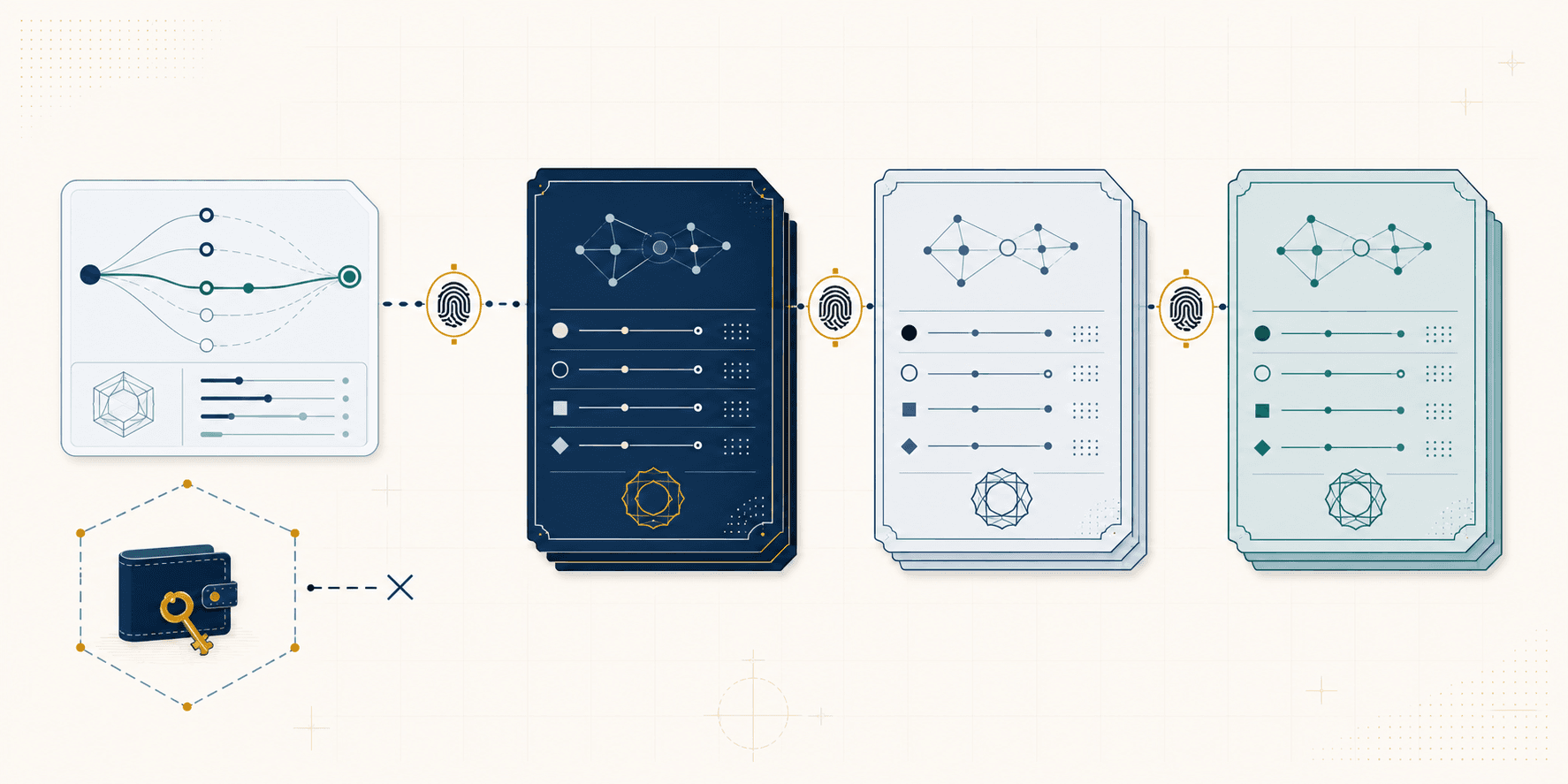
What a historical stress test actually measures
A crypto portfolio stress test takes the supported holdings you hold today and re-prices them through a past market shock — a specific historical window such as a sharp drawdown, a stablecoin depeg, or a liquidity crunch. Routescore applies the price moves that actually happened in that window to your current supported positions and reports the modeled change in portfolio value, position by position. The output is a what-would-have-happened figure, not a projection of what comes next.
The point is perspective, not prediction. Replaying a real historical shock on the holdings you have now shows how concentrated or resilient the current mix looks against an event that has already occurred, so you can size and decide with that context in hand. It makes no claim that the next shock will look like the last one — replaying the past is a way to pressure-test today, nothing more.
- A modeled change in portfolio value for a named historical shock window.
- Position-by-position re-pricing across your supported holdings.
- Plain-language framing of which positions drove the modeled drawdown.
- A historical replay — explicitly not a prediction of future moves.
What "supported holdings" means — and what gets excluded
A stress test is only as honest as the assets it can actually price. "Supported holdings" are the tokens and positions in the launch-static holdings catalog that Routescore has historical price series for across the modeled shock windows. Those are the positions that get re-priced. Anything outside that set — unsupported tokens, illiquid or thinly traded assets, off-chain holdings, and positions on unsupported chains — is marked and excluded rather than approximated with a guessed price.
That exclusion is deliberate and visible. An unsupported asset is shown as out of scope on the artifact, so a coverage gap never masquerades as a low-impact result. A stress figure that quietly dropped half your book would be worse than no figure at all, so the excluded share is named alongside the modeled one.
- Supported tokens and positions are re-priced from the launch-static holdings catalog.
- Unsupported tokens, chains, and off-chain assets are marked out of scope, not approximated.
- The modeled change covers only the supported slice — the excluded share is shown, not hidden.
How to read a stress result — and what it does not claim
Read the headline figure as "this is how the supported slice of my holdings would have moved through that specific past shock," then read the per-position breakdown to see what drove it. A large modeled drawdown concentrated in one position is a reason to look harder at that concentration; it is context for your own decision, not a verdict. Routescore shows the modeled result and the caveats and leaves the call to you.
What it deliberately does not do is forecast. There is no prediction of future prices, no probability that a similar shock recurs, and no advice to buy, sell, or hold. It replays historical scenarios on your current supported holdings — nothing in the output is a claim about what will happen, and none of it is investment advice. Treat it as one pre-decision input you weigh alongside everything else you know.
- Headline modeled change for the supported slice of your holdings.
- Per-position breakdown of what drove the modeled drawdown.
- No forecast, no probability of recurrence, no buy / sell / hold advice.
From a public sample to a private, reviewable record
The scenario on this page is a static public sample — a worked example of a historical stress scenario re-pricing a fixed set of supported holdings, kept here so the method is inspectable before you sign in. The live stress test, where the replay runs against your own supported holdings, is the gated /stress-test tool. Keeping the public sample and the private tool separate is intentional: the SEO page shows the shape of the output, and the tool does the work on your data behind sign-in.
When you run the real thing, saving the scenario leaves a decision record — the shock window, the supported holdings priced, the model and holdings-catalog versions, source freshness, and the caveats that applied. Later you can revisit that record and review whether the concern it surfaced held up. Run a stress test, save the record, review it later: that loop is what turns a one-off replay into calibration evidence over time, in the open rather than by assertion.